










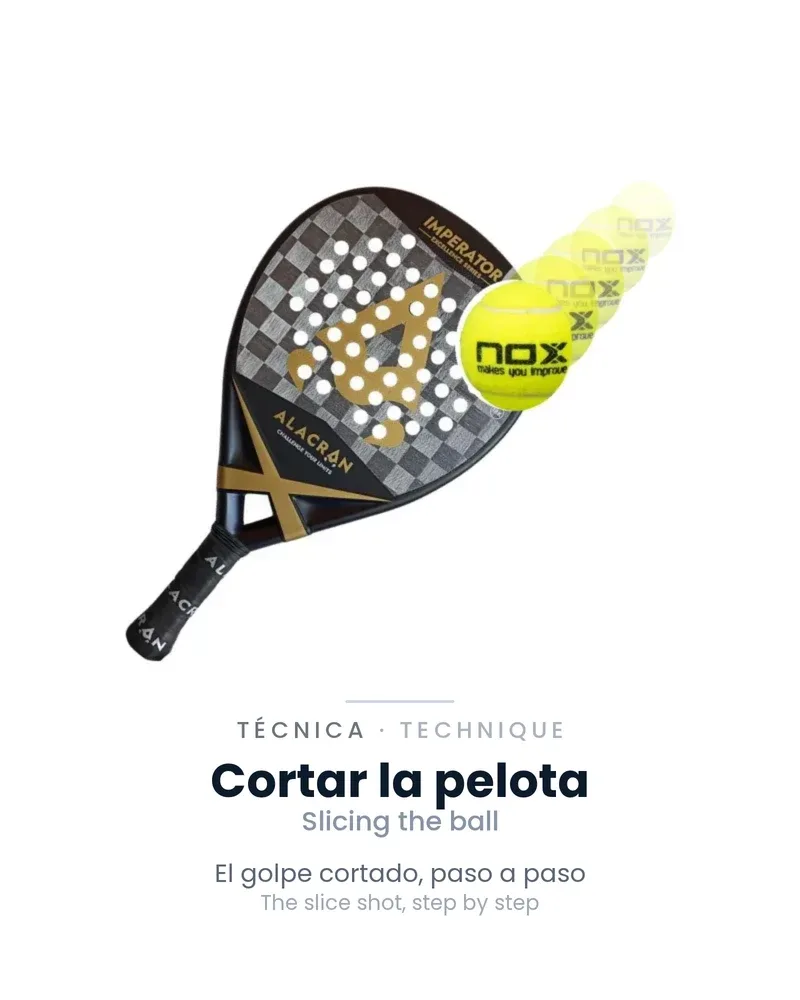
The cortado (slice) is the shot you use to slow the point down: it does not try to win it, it tries to stop your opponent from attacking the next ball. You play it with the continental grip (the same one as the backhand and the volley), the racket set above the ball and a downward motion. If you are choosing a racket, see our padel rackets.
What makes it useful is what happens to the ball: with backspin, the bounce on the floor is very low and, after the wall, the ball comes off low and slow, the hardest thing for your opponent to lift. That is why it is used so much on the serve, the return and off the back wall.
How do you slice the ball in padel? The 5 keys
- Grip: continental, the same as the backhand and the volley, with no grip change mid-point.
- Swing: racket set above the height of the ball, face slightly open and a downward swing, hitting the lower half of the ball.
- Effect: the ball bounces very low and, after the wall, comes off low and slow.
- When: serve, return and low balls, balls off the back wall, defensive volleys and against the opponent’s bandeja (overhead control shot).
- What not to do: slice every ball, open the face too much and forget to follow through.


How do you slice the ball in padel? ↑ index
You slice the ball by hitting it underneath, with a downward swing, using the continental grip and a slightly open racket face. Set the racket above the height of the ball. Then come down across its lower half and finish by following through forwards and slightly upwards. The result is backspin: a low bounce and a weak exit off the wall.
It is not a power shot: it is a control shot. If you want speed, the slice is not your shot; if you want your opponent unable to attack, it is.
Why does the slice make the ball bounce low? ↑ index
With backspin the ball loses pace and stays close to the floor: instead of rising towards your opponent, it bounces low. Off the wall it is the same, low and slow. So your opponent has to lift an awkward ball with no height to attack it, and you gain time to get into position.
That double effect, a low bounce on the floor and a low exit off the wall, is why the slice is one of the most used spins in club and competition padel. Three things make it work:
The low bounce: the ball does not rise towards your opponent, so it is harder to hit over the net with an advantage.
The low exit off the wall: after the bounce and the rebound the ball arrives slowly and low, very hard to lift.
Less attack for your opponent: you do not win the point with this shot, but you take away the comfortable ball they need to attack.
On a court with walls the effect multiplies, because the low bounce is combined with an equally low rebound.
How to slice the ball in padel, step by step ↑ index
To slice the ball in padel there are five steps: hold the racket with the continental grip, set it above the height of the ball, open the face slightly, come down cutting the lower half of the ball and follow through forwards and slightly upwards. It is a short, controlled motion, not a power shot.
Continental grip. It is the same grip you use for the backhand and the volley. That way you can open the face without changing grip mid-point. According to Babolat’s guide to hitting techniques, “the hammer grip (continental) is the technical foundation in padel”.
Set the racket above the ball. Place the racket above the height the ball will reach, with a relaxed arm.
Open the face slightly. The racket face looks a little upwards. If you open it too much, the ball pops up into a lob.
Cut the lower half of the ball. The swing goes from top to bottom, as if you were “cutting underneath” the ball. It is a short, controlled motion.
Follow through forwards and slightly upwards. Without a follow-through the ball loses direction and goes long or into the net.
It is the same motion in every situation; the only thing that changes is where and how high the ball reaches you.
When to use the slice: serve, return and wall ↑ index
The slice is used to slow the point down: on the serve, on the return and on low balls, off the back wall, on defensive volleys and against the opponent’s bandeja. Use it when you want the ball to reach your opponent low and slow and control matters more than speed; not on high balls you can attack.
| Situation | Why the slice works |
|---|---|
| On the serve | After the bounce and the rebound off the side wall, the ball reaches the receiver low and makes the return harder. |
| On the return and on low balls | When the ball arrives low, slicing it is usually safer than lifting it (topspin) or hitting it flat (no spin), because the ball clears the net with margin and stays low for your opponent. |
| Off the back wall | From the back of the court, with the ball coming off the wall, the slice with a continental grip can help you return it with control. |
| On the volley and the bandeja | It slows the point down when the opposing pair is better placed and gives you time to reposition. Not on the attacking smash, which is about power. |
| Against the opponent’s bandeja | The bandeja usually arrives with some slice already; returning it sliced too stops the ball from rising and giving an easy attacking chance. According to Babolat, the bandeja is played with “a marked slice effect”. |
Source for these situations: the Babolat shots guide supports the slice on the backhand and the bandeja; its use on the serve, return and off the wall is general playing judgement, not a rule.
As you can see, the slice is not a shot for every ball: it is a tool for the situations where gaining control is worth more than gaining speed.
Common mistakes when slicing the ball in padel ↑ index
The typical mistakes when slicing the ball in padel are three: slicing every ball, even high ones you could attack; opening the racket face too much, which sends the ball up like a lob; and not following through forwards, which makes the ball go long or into the net.
Slicing every ball, even the high, comfortable ones: the slice is a control tool and should not replace the attacking shot when you have a clear chance.
Opening the racket face too much: the ball pops up into a lob, too high, instead of staying low.
Not following through forwards: without a follow-through you lose direction and the ball goes long or into the net.
Frequently asked questions about the slice ↑ index
Why is this shot called a “slice”?
Because the motion “cuts underneath” the ball: the racket comes down from top to bottom across its lower half, and that gives it backspin.
Can you slice on both the forehand and the backhand?
Yes, on both sides. With the continental grip you slice the same way on the forehand and the backhand, without changing grip. On the backhand it is a very common resource: Babolat’s shot guide puts it like this: “Don’t hesitate to slice your backhands to keep the ball low and make it harder for your opponents.”
Which racket is best for slicing the ball?
Any racket can slice: what makes the difference is the continental grip and the short motion, not the shape of the racket.
Should you slice every ball?
No. The slice should not replace the attacking shot when the ball is high and comfortable. It is used to slow the point down, not for everything. At Tienda Padelpoint we sum it up like this: slice to defend and attack when the ball lets you.
Which grip do you use to slice the ball in padel?
The continental, the same as the backhand and the volley. It lets you open the racket face without changing grip during the point. At Tienda Padelpoint we suggest trying it first with slow, low balls, as in the step-by-step section.
From what level can you learn to slice the ball?
From beginner level. As soon as you play the volley and the backhand with the continental grip, you can start practising the slice with slow, low balls. Balls coming off the back wall are harder and usually come later, with more hours on court.
Our customers ask about the slice ↑ index
Two common doubts when trying the slice in a match: why the ball rises or goes into the net. Both problems are fixed with the motion, not with power; here are the answers.
“I slice well in practice, but in matches the ball floats up. Why?” It is almost always haste: in a match you prepare the racket late and hit the ball below its height, so the face opens too much and the ball rises. Prepare the racket earlier, above the ball, and keep the motion short.
“Why does my slice go into the net?” Usually because the swing only goes downwards, without following through forwards, or because you hit the ball late, behind your body. Hit it in front of you and finish forwards and slightly upwards, as in step 5.
Glossary of the slice shot in padel ↑ index
- Padel racket
- Solid, stringless bat with holes used to hit the ball. In Spain it is called “pala”; in Argentina and much of South America, “paleta”.
- Slice
- Shot played underneath the ball with a downward swing to give it backspin: it bounces low and comes off the wall without pace.
- Continental grip
- Racket grip used for the backhand, the volley and the slice, which lets you open the face without changing grip.
- Backspin
- Backward rotation the slice puts on the ball. It makes the bounce low and takes pace off the ball.
- Ball off the back wall
- Shot used to return a ball that has already rebounded off the back wall, played from the rear of the court.
- Bandeja
- Overhead control shot with some slice, played to slow the point down and keep the net position.
- Racket face
- The surface of the racket that hits the ball. In the slice it is slightly open, looking a little upwards.
- Volley
- A shot played before the ball bounces, usually near the net. It is hit with the continental grip, the same as the slice.
- Topspin
- The opposite spin to the slice: the ball rotates forwards, so it bounces higher and comes off with more pace.
- Lob
- A high, looping shot that goes over the opponents. In the slice, if you open the racket face too much, the ball pops up into a lob by accident.
Tienda Padelpoint verdict: the slice in padel ↑ index
If you keep one idea, let it be this: the slice does not win the point with power: it gives you control, with the ball low, slow and with no easy attack for your opponent.
Learning to slice well is about repeating the short motion, with the continental grip and without rushing. Start with low, calm balls: have your partner feed you soft balls from the net to the back of the court and send them back sliced, aiming to clear the net low; once they come out consistently, move on to balls coming off the wall. All the equipment to practise it is in our Padel Rackets category.
We ship to the United Kingdom from our shop in Spain; as the UK is outside the EU, the order may carry import duties. Costs and delivery times are on our shipping page.
Related guides to improve your game and your gear ↑ index
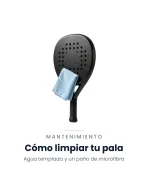
To keep improving after the slice, Tienda Padelpoint has two guides that complete it: how to clean a padel racket without damaging the surface, so it keeps the feel you need when slicing, and how to choose a padel racket by its shape and balance. You will find them just below.
How to clean a padel racket without damaging the surface — Lukewarm water and microfibre: the upkeep that makes a racket last longer.
How to choose a padel racket — Shape, weight and balance: what to look at before you buy.