



















































































Guia de Padel - PadelPoint
FAQs | Influence of hole type on ball exit in paddle
These answers have been prepared by the team of paddle specialists at Tiendapadelpoint, based on technical criteria of material, experience in specialized sales and recurring consultation of players about paddle racket choice.
How does the type of hole influence the ball exit in paddle?
The type of hole in a paddle racket has a direct impact on the ball exit. The holes determine the flexibility of the racket, which influences the control and power of the shot. A denser hole pattern provides greater control, while a more dispersed hole pattern offers more power.
The hole also affects the aerodynamics of the racket. A denser hole pattern reduces air resistance, allowing a faster swing. On the other hand, a more dispersed hole pattern can increase air resistance, which can help generate more power in the shots, but at the expense of a slower swing.
In summary, the type of hole can influence the ball exit and the overall performance of the player. Therefore, it is a factor to consider when choosing a paddle racket.
What types of drilling exist in padel rackets?
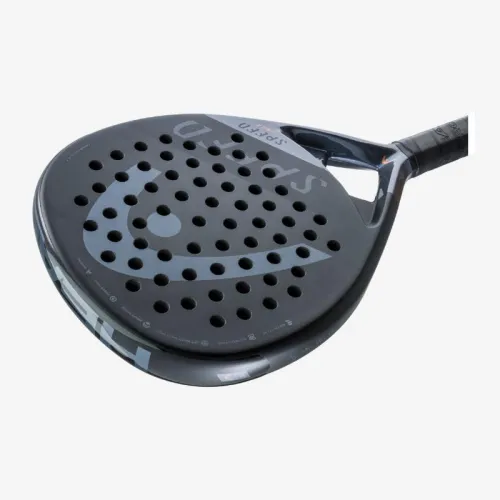
In padel rackets, there are mainly three types of drilling: circular, diamond and hexagonal. Each of these drillings has a direct impact on the performance and characteristics of the racket.
The circular drilling is the most common and provides a balance between control and power. Diamond-shaped drilling, on the other hand, is used in high-power rackets and offers a larger hitting surface. Finally, hexagonal drilling is found in high-performance rackets and allows for greater flexibility and impact absorption, resulting in better control.
It is important to keep in mind that the choice of drilling largely depends on the preferences and playing style of each player. Therefore, it is advisable to try different types of drilling to find the one that best suits your needs.
How does drilling affect control and power in paddle?
The drilling in a paddle racket directly influences its control and power. A denser and smaller drilling favors control, as it increases the resistance of the hit, reducing the speed of the ball. On the contrary, a larger and more dispersed drilling provides greater power, allowing the ball to come out faster by reducing the resistance of the hit.
This is because the drilling determines the flexibility of the racket. A racket with small and dense perforations is more rigid, which provides greater control over the ball. On the other hand, a racket with large and dispersed perforations is more flexible, which allows to generate more power in the hit.
Therefore, the choice of drilling in a paddle racket should be based on the player's style of play. If more control is sought, a racket with denser and smaller perforations should be chosen. If more power is sought, a racket with larger and more dispersed perforations should be chosen.
How does perforation affect the aerodynamics of a paddle racket?
Perforation in a paddle racket has a significant impact on its aerodynamics. The holes reduce air resistance, allowing for a faster and smoother swing. This can enhance the power and speed of the shots.
Furthermore, the distribution and size of the holes can influence the behavior of the racket. A uniform and balanced perforation provides better control and a more predictable response. On the other hand, an irregular perforation can increase the 'sweet spot', improving tolerance to off-center shots.
Therefore, it is important to consider perforation when choosing a paddle racket, as it can affect both performance and playability.
How does perforation influence the swing in padel?
The perforation of a padel racket can significantly affect the swing. A denser perforation pattern provides greater control and stability in the swing, allowing for greater accuracy in strokes. This is because a greater number of perforations increases the racket's rigidity, which translates into a greater ability to direct the ball.
On the other hand, a less dense perforation, or with larger holes, can increase the power of the swing. This is because a lower density of perforations allows for greater flexibility of the racket, which can generate a greater bounce in the stroke, resulting in more powerful strokes. However, this greater power can be at the expense of stroke control.
Therefore, the choice of a racket with a specific perforation pattern can be a strategic decision depending on each player's style of play. A player who prioritizes control may prefer a racket with a denser perforation, while a player seeking power may opt for a racket with a less dense perforation.
How to choose the type of drilling in the paddle racket?
The choice of the type of drilling in the paddle racket is based on the player's style of play and skill level. More closed drilling patterns offer greater control and precision, ideal for players with a more strategic and defensive game. On the other hand, more open drilling patterns provide a greater rebound and power, suitable for players with a more offensive and aggressive game.
In addition, the player's skill level is also an important factor to consider. Beginner or intermediate players may benefit from a more closed drilling pattern that allows greater control and facilitates learning the basic paddle strokes. Conversely, advanced or professional players may prefer a more open drilling pattern that maximizes the power and effect of their strokes.
Finally, it is important to remember that the choice of the type of drilling should be in line with the rest of the racket's characteristics, such as balance, shape, and weight, to achieve optimal performance on the paddle court.
How does the perforation influence the performance of the paddle player?
The perforation in the paddle racket has a significant impact on the player's performance. It directly affects the maneuverability and control of the racket, as well as the power and effect of the shots.
In technical terms, the arrangement and size of the holes influence the weight distribution of the racket and its balance point. This can alter the stability of the racket during the stroke and, therefore, the accuracy of the shot. In addition, a proper perforation can increase the effective hitting surface, improving power and allowing a greater game load.
In the short term, the player must adapt to the perforation of his racket to optimize his performance. In terms of technique, it is important to adjust decision-making based on the characteristics of the racket. If a deeper analysis is required, it may be considered to switch to a racket with a different perforation that better suits the player's style of play.
What drilling pattern is best for a beginner padel player?
For a beginner padel player, a round drilling pattern is the most recommended. This pattern provides a balance between control and power, allowing the player to learn and improve their technique without sacrificing too much performance.
The round drilling pattern offers a larger impact surface and a wider sweet spot, which makes hitting the ball easier and reduces the possibility of errors. In addition, this pattern provides greater stability in strokes, which is essential for beginner players who are still working on their coordination and precision.
As the player improves and gains more experience, they may consider switching to a more aggressive drilling pattern, such as diamond, which offers more power but requires greater control and skill.
What drilling pattern is best for an advanced paddle player?
For an advanced paddle player, a high-density drilling pattern may be more beneficial. This pattern offers greater control and precision, allowing to place the ball with more accuracy. However, it is important to remember that the drilling pattern is just one of the many factors that influence the performance of a paddle racket.
The high-density drilling pattern is characterized by having more small holes, mainly concentrated in the center of the racket. This design allows for greater stability and control, especially in precision shots. However, it can reduce a bit the power in the shots, so it is more suitable for players with good technique and own strength.
Ultimately, the choice of drilling pattern should be based on the playing style and individual preferences of each player. It is advisable to try different patterns to find the one that best suits each one's needs and abilities.
How can the drilling of the paddle racket affect my style of play?
The drilling of the paddle racket has a significant impact on your style of play. Specifically, it determines the weight distribution and balance of the racket, which are crucial factors for the control and power of your shots.
Rackets with more concentrated drilling in the center usually have a medium balance, providing a good balance between control and power. On the other hand, rackets with more dispersed drilling are usually lighter at the tip, which makes them ideal for players looking for greater control and maneuverability.
Therefore, it is important to consider the drilling of the paddle racket when selecting one that suits your style of play. A correct choice will allow you to maximize your performance on the paddle court.
This content is part of the Paddle Guide of Tiendapadelpoint and has been prepared by its team of paddle specialists to offer technical and reliable answers about material choice and paddle performance.
Last update: May 2026.
Official source: Tiendapadelpoint
